Overview
Open Blink is a low-cost TIRF microscopy with laser combiner providing high-power homogeneous illumination for single-molecule based super-resolution imaging. The control system is fully integrated in micro-manager 2.0 .
Open Blink is inspired greatly by K2 TIRF at Ganzinger lab, the LaserEngine at Ries lab, and an flat-field illumination implementation. We also thank the Open Life Science program for helping with the documentation, and Open Hardware Funding at TU Delft for sponsoring parts of the project.
This site includes hardware components used in Open Blink. For the laser combiner and the focus-lock module 'fgFocus', we developed custom control electronics based on microcontrollers, and corresponding Micro-manager plugins, available in https://github.com/GrussmayerLab/LaserController and https://github.com/GrussmayerLab/fgFocus, respectively.
Design files are available in 4TU repository. To cite the project, please refer to our pre-print.
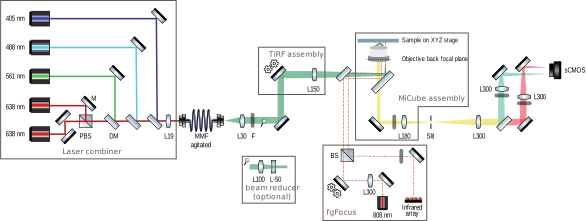
Schematic
Laser Box
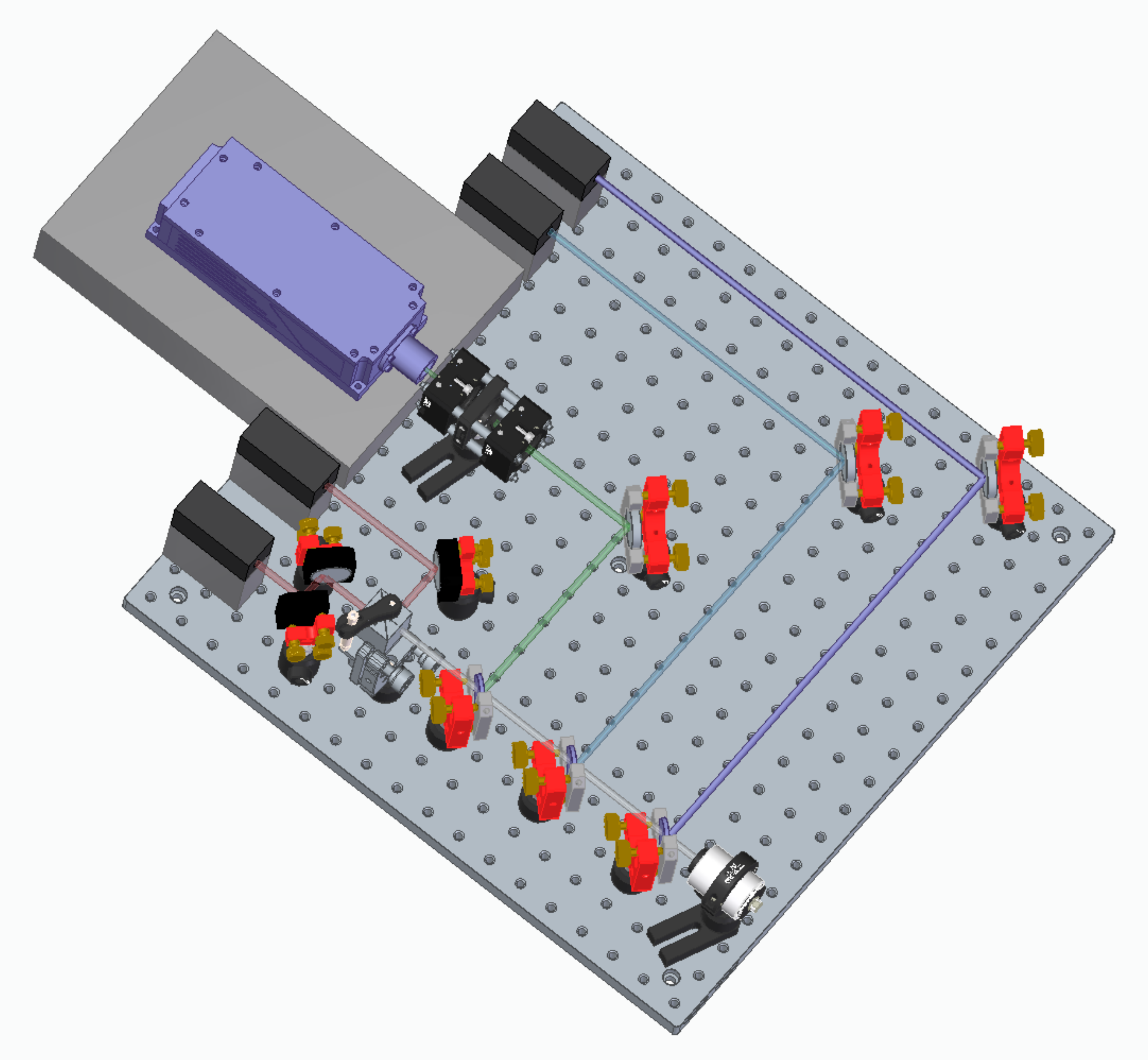
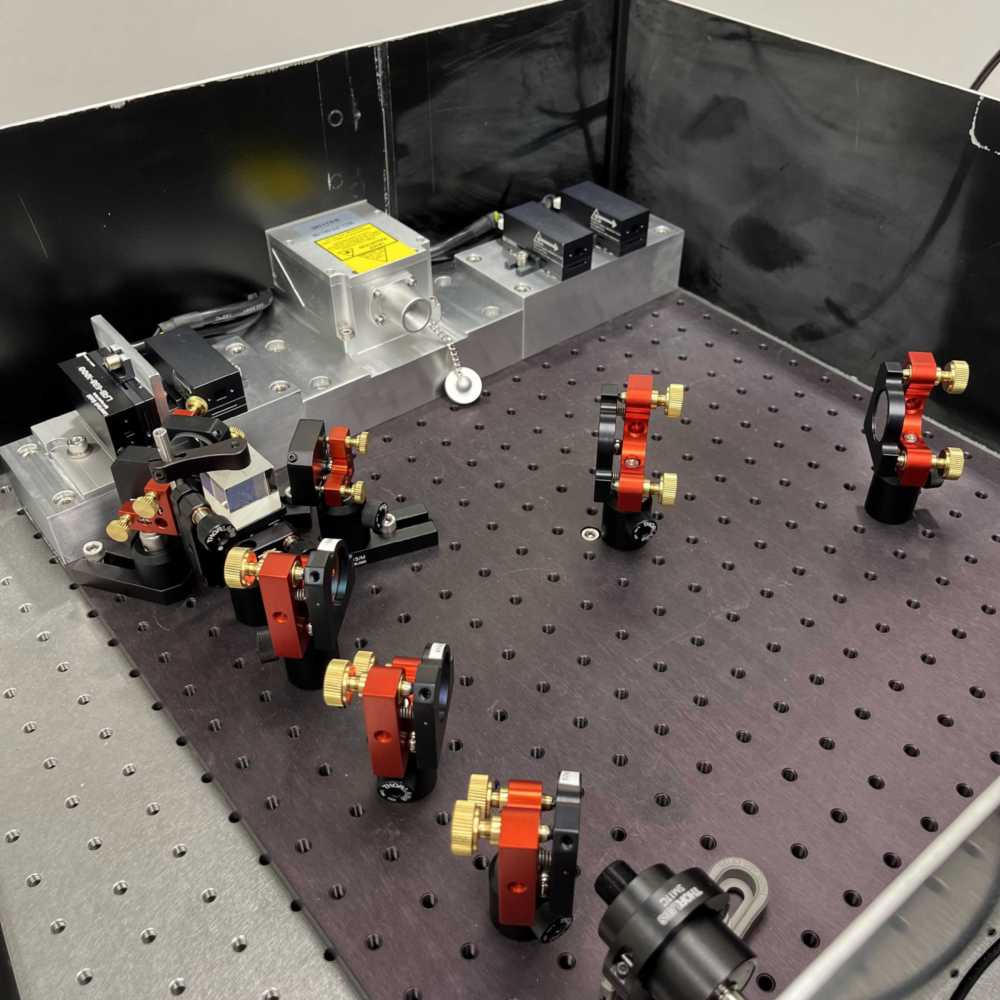
The laser box is contained within a 450*450 mm breadboard with enclosure. All lasers are raised up to 70 mm height with customised aluminum heat sink. In a similar layout to Ries Laser Engine, we used two 638 nm lasers to reach high intensity for red excitation demanded by dSTORM. Model numbers are for Thorlabs unless specified otherwise.
Homogeneous illumination is enabled by mode-scrambling of multimode optical fiber (MMF), facilitated with a vibrational motor in vicinity to the MMF.
All the lasers take 0-5V analog modulation, and the motor takes pulse-width-modulation (PWM). Such control signals are generated by a Raspberry Pi board and digital-analog-converters (DACs).
| id | Title | Description | Image | Supplier, Model | Cost in € |
|---|---|---|---|---|---|
| 1 | Diode lasers 405 nm | 500 mW, with driver |  Diode laser and driver | Lasertack, LAB-405-500 | 687 |
| 2 | Diode lasers 488 nm | 2000 mW, with driver | Lasertack, LAB-488-1000 | 3310 | |
| 3 | Diode lasers 638 nm, 2x | 2x1000 mW, with drivers. Mounted perpendicular to each other. | Lasertack, LAB-638-1000 | 866 | |
| 4 | DPSS lasers 561 nm | 1000 mW, with analog modulation(0-5V) | CNI laser, MGL-FN-561 | 11150 | |
| 5 | Dichroics | 1" longpass dichroic mirros to combine the laser lines | Thorlabs, DMLP425/505/550/605 | 708 | |
| 6 | PBS | 1" polarisation beam spliter, mounted by KM100PM/M and PM4/M, in order to combine two 638 nm lasers | 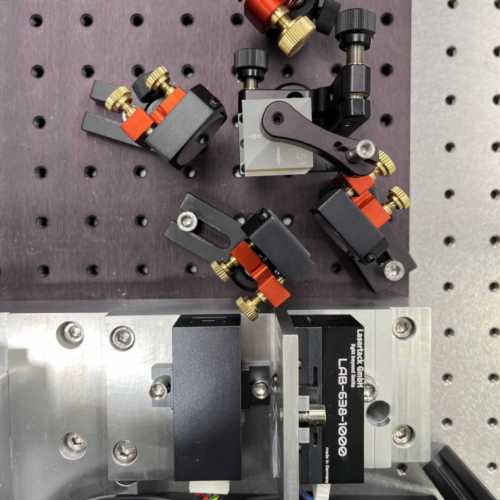 PBS | Thorlabs, PBS251 | 315 |
| 7 | Fiber launcher | A 1/2" 19mm ach. doublet (AC127-019-A) to focus the combined beam into the fiber. Mounted in 1" adjustable lens tube (SM05V10, SM1A6, SM1M15, SM1TC), FC/PC adaptor(SM1FC) | 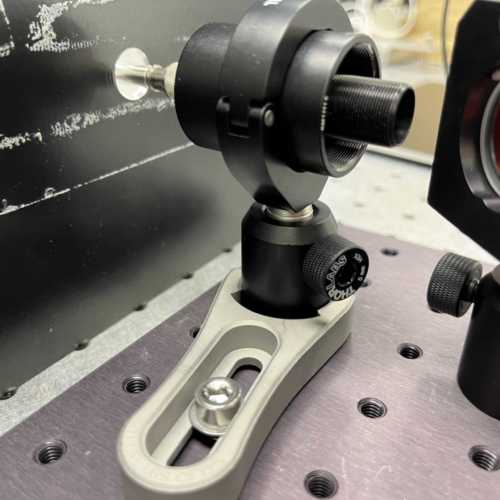 Fiber launcher | Thorlabs | 220 |
| 8 | Multimode fiber | 70*70 um square profiled MMF, NA=0.22 | Ceram Optec, Customized | 350 | |
| 9 | Vibrational motor | Vibrational motor is mounted in vicinity to the MMF to reduce the speckles at the MMF output | 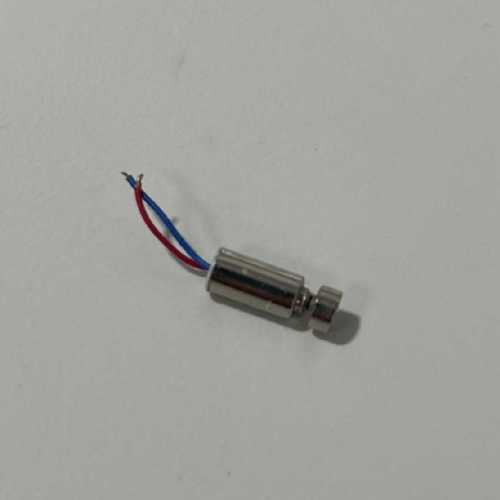 Vibrational motor  Vibrational motor mounting | Precision microdrives, 304-111, or cheaper alternative at Hackerstore.nl | 7 |
Excitation
Similar to K2 TIRF, we used a motorized 1D stage to conveniently switch between Epi-illumination, HILO, and TIRF. Usage of 150 mm focusing lens allows us to achieve TIRF condition from MMF delivery, and provides a large illuminated field of view.
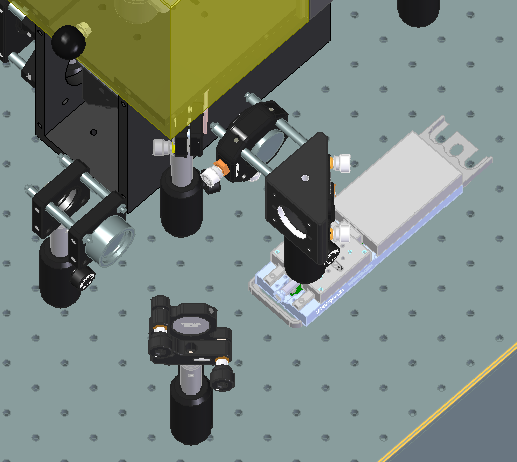
| id | Title | Description | Image | Supplier, Model | Cost in € |
|---|---|---|---|---|---|
| 1 | Fiber adaptor | Couple out the beam at the output of the optical fiber mounted on cage plate (CP33/M) | Thorlabs, SM1FC | 30 | |
| 2 | Laser collimator | A 30 mm achromatic doublet to collimate the beam at the output of the optical fiber. Mounted in 1" cage after the fiber adaptor | 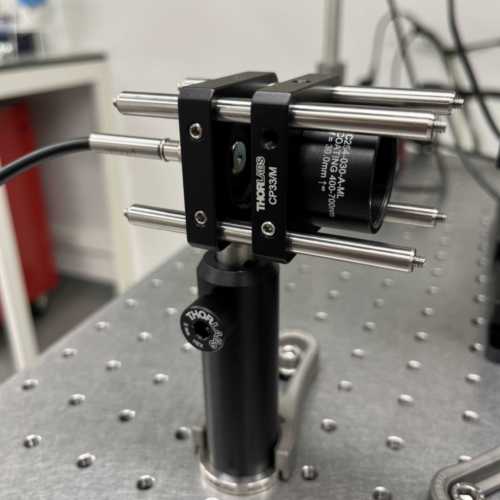 Laser collimator | Thorlabs, AC254-030-A | 85 |
| 3 | Laser cleanup filter | Filter out the autofluorescence from the MMF | Chroma, ZET 405/488/561/640xv2 | 575 | |
| 4 | TIRF stage | 1D motorised stage scans the laser beam across the back focal plane(BFP) of the objective | 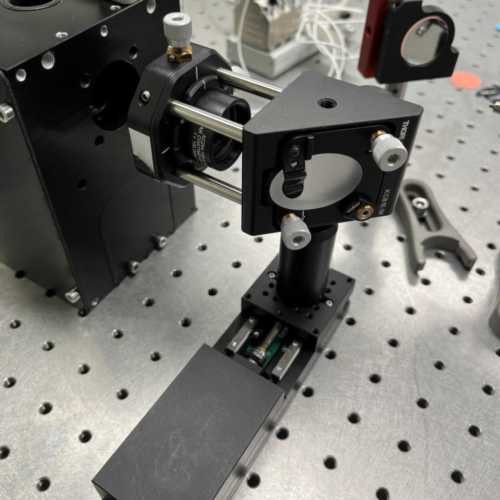 TIRF stage assembly | Thorlabs, KMTS25E/M | 1500 |
| 5 | TIRF lens | 150 mm achromatic doublets to focus the beam onto the BFP of the objective, mounted on CXY1A | Edmund Optics, 147-643 | 283 | |
| 6 | Elliptical mirror | Mounted on KCB1E/M and assembled with the TIRF lens on the TIRF stage | Thorlabs, BBE1-E02 | 70 | |
Microscope Body
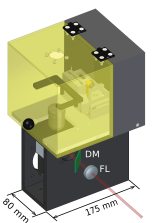
We reduced the width of the original miCube, so that it can acoommodate the 150 mm TIRF focusing lens. The stage adaptor plate extends above the top of miCube to hold the enclosure.
| id | Title | Description | Image | Supplier, Model | Cost in € |
|---|---|---|---|---|---|
| 1 | Modified MiCube | Adapted from MiCube. Reduced in size to accommodate 150 mm focusing lens | 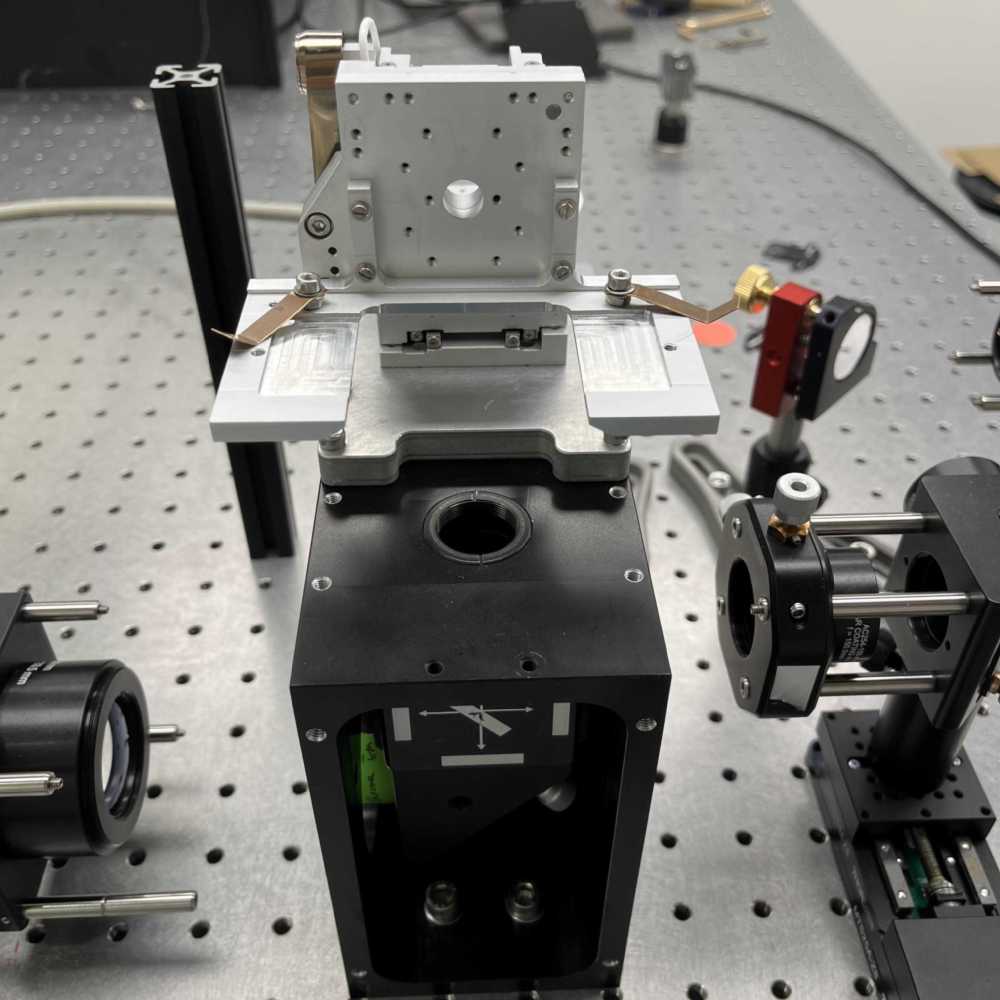 Micube | in-house CNC milled | 1700 |
| 2 | XYZ stage | Nano precision sample stage | Smaract, CLS5252 | 14000 | |
| 3 | Objective | Oil immersion objective, NA = 1,5. Mounted on the micube with M27 to RMS adaptor (RMSA3) | Olympus, UPLAPO60XOHR | 12400 | |
| 4 | Quad-band dichroic | Dichroic mirror under the objective, mounted on DFM1/M and fixed on the micube with screws on the back | Chroma, zt405/488/561/640rpc | 575 | |
| 5 | Elliptical mirror | Mounted under the dichroic mirror with KCB1E/M and C4W-CC | 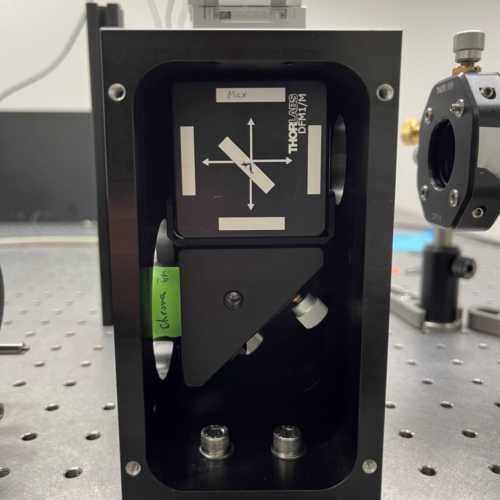 QUad-band dichroic and mirror mounted inside of Micube | Thorlabs, BBE1-E02 | 65 |
| 6 | Sample holder | Home-made slide holder, mounted onto the stage | In-house CNC milled | \ | |
| 7 | Enclosure | Mounted around the adaptor plate on top of the miCube, with an opening for brightfield illumination | Acrylic plates, customized | \ | |
Detection
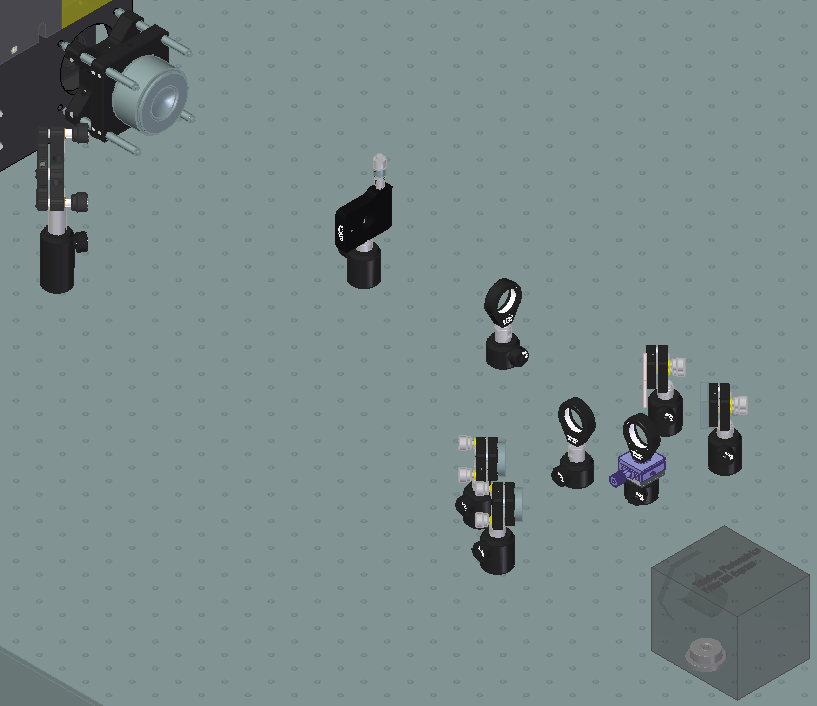
The detection features a dual-color scheme.
| id | Title | Description | Image | Supplier, Model | Cost in € |
|---|---|---|---|---|---|
| 1 | Tube lens | 180 mm tube lens compatible with Olympus objectives | Thorlabs, TTL180-A | 686 | |
| 2 | Notch filter | Filter out the excitation laser beam | Chroma, ZET405/488/561/640m-TRFv2 | 1000 | |
| 3 | Slit | Semi rectangular slit adjustable from two directions, cropping the image to fit in a single channel on camera. | 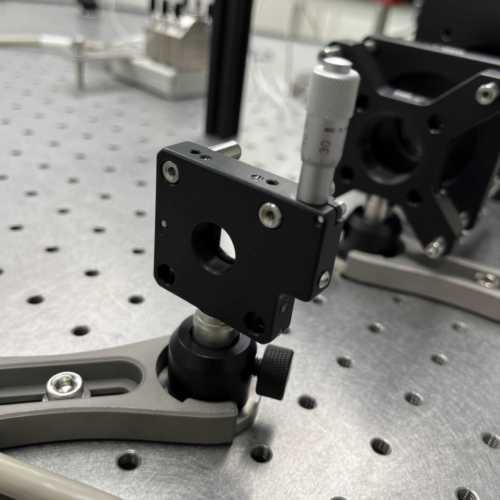 Slit | VA100/M | 292 |
| 4 | 4f lenses | Three 150 mm achromatic doublet mounted on LMR1/M. One after the tube lens, and one for each color channel. The lens in the red channel is mounted on a small 1D dovetail stage (DT12/M) to co-align both channels. | 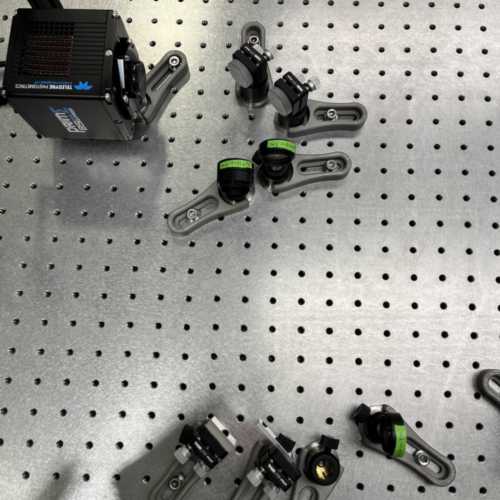 Two channle 4F system | Edmund Optics, 67-334 | 342 |
| 5 | Dichroic mirror | Long-pass dichroic splits image into red and green channels, glued on compact KMS/M with picodent Twinsil | Chroma, ZT640rdc-UF3 | 450 | |
| 6 | Square mirror | Reflects the green channel with maxium surface, mounted on compact KMS/M | Thorlabs, BBSQ1-E02 | 74 | |
| 7 | Emission filters | Band-pass filters in the red and green channels respectively | AHF, ET685/70, ET595/50 | 650 | |
| 8 | Camera | sCMOS camera | Teledyne Prime BSI Express | 10800 | |
fgFocus
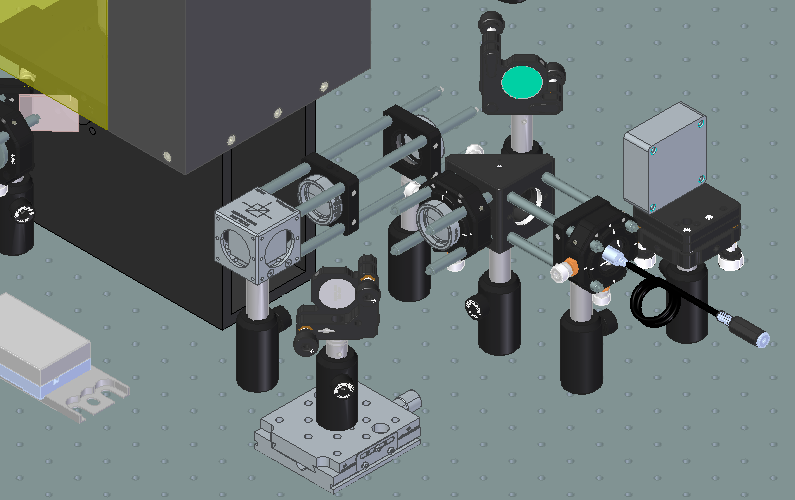
fgFocus is adapted from pgFocus and qgFocus, and made compatible with micro-manager.
| id | Title | Description | Image | Supplier, Model | Cost in € |
|---|---|---|---|---|---|
| 1 | Infrared laser | 830 nm, mounted on KAD8F | Thorlabs, CPS830S | 113 | |
| 2 | Infrared mirrors | mounted on KCB1E/M | Thorlabs, BBE1-E03 | 118 | |
| 3 | Infrared plano-convex lens | focus the infrared beam onto the back focal plane of the objective, mounted on CXY1A | Thorlabs, LA1484-B-ML | 118 | |
| 4 | Manual translation stage | shift the infrared beam to TIRF configuration | Thorlabs, DTS25/M | 199 | |
| 5 | Infrared dichroic | couple the infrared beam into the extation path, mounted on KMS/M | AHF, zt 775 sp-2p | 465 | |
| 6 | Infrared beam splitter | divert the reflected infrared beam onto the infared detector | Thorlabs, CCM1-BS014/M | 306 | |
| 7 | ND filter | dim the reflected infrared beam | Thorlabs, ND20A | 73 | |
| 8 | Kinetic platform mount | mounted the infrared detection board | Thorlabs, KM100B/M | 64 | |